
How it works
Autonomy grows at the speed of the record.
Virgil stands the watch · your engineers sign · your audit trail decides what runs on its own.
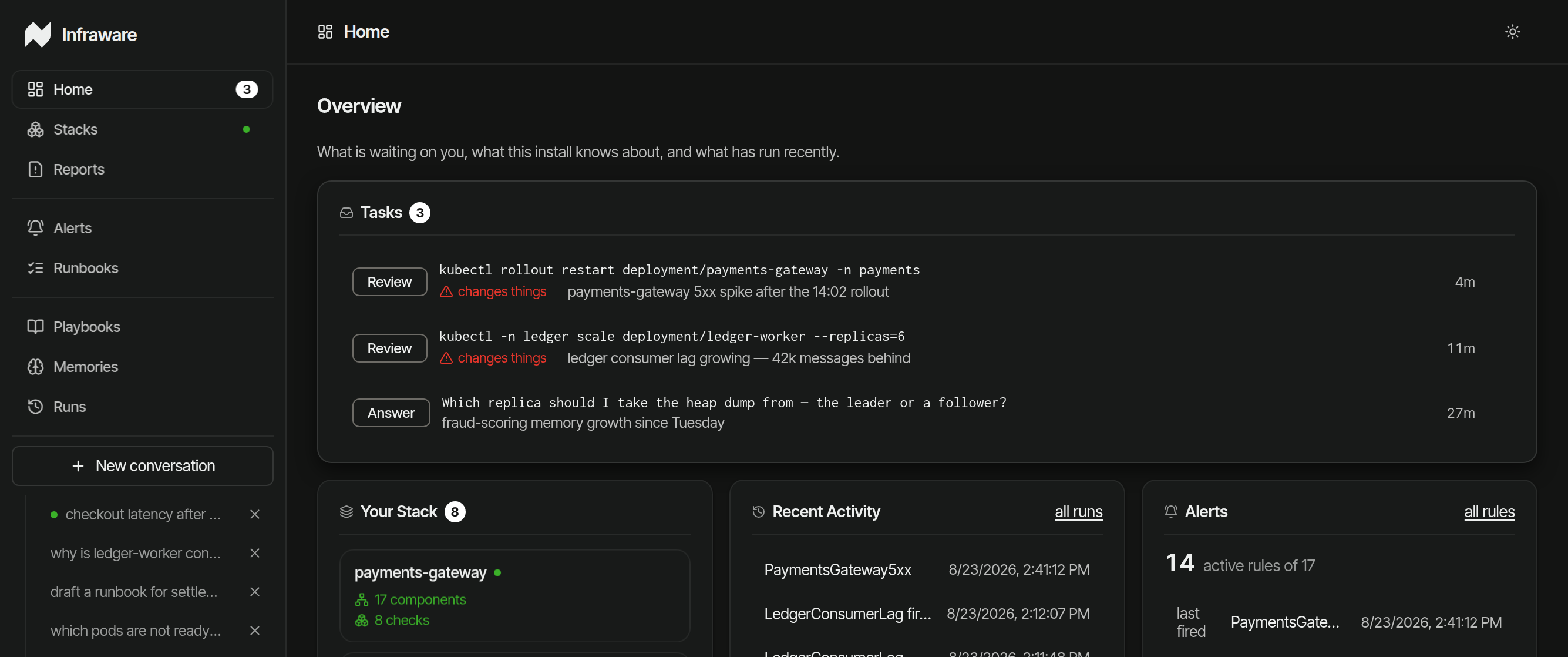
It investigates
On its own. Read-only, by construction.
Every command checked against a fixed allowlist, watch a delete get blocked mid-run, on the record. How read-only is enforced →
It briefs you
You wake up to a brief, not a blank terminal.
Root cause, evidence, one proposed fix. Proposed, not executed. The 25-minute live version →
You sign
Nothing changes production without a name on it.
The fix runs under an identity mapped from the approval; one audit entry lands beside your security logs. The identity model →
It learns yours
Day one it knows Kubernetes. Month one it knows you.
It drafts the runbook from the run; your engineers edit it, own it, delete it. Where this is going →
The ladder
Autonomy is earned, not toggled.
When your record shows the same fix approved identically, again and again, sign it once as policy: a routine. Same identity binding, same audit line, the grant traced to its signer. Revoke the signature and the pause returns.
routine #4 · standing signature
- pattern
kubectl rollout restart deployment/payments-gateway -n payments- evidence
- approved identically 12× · 2026-06-14 → 2026-08-02 · zero rejections
- signed as policy
- a.rivera · 2026-08-05
- every run since
- same identity binding · same audit line · grant traced to its signer
This is what a rung looks like when it is earned: not a toggle, a receipt. Autonomy grows at the speed of the record, and never faster.
A note on category
Why we’re not an AI SRE.
Every vendor in this market races to answer “what happened?” faster: a race the models themselves are commoditizing. We built the layer the race ignores: the one that decides what is allowed to act on the answer.
CATEGORY
| The question | Infraware | An AI SRE |
|---|---|---|
| What does it optimize? | Accountability per change | Minutes to diagnosis |
| Where does autonomy come from? | Your accumulated record | Model confidence settings |
| What does the audit answer? | Who approved what, on what evidence, and what ran | What the agent did |
| What is the end state? | A governed pathway any agent can run through | A faster engineer on shift |
The long version, argued properly: Why we’re not an AI SRE →